Thursday, 25 February 2016

Assignment 2 - Preparations

Assignment 2 Preparations

I've been thinking about this already and using some of the influences mentioned earlier and that I've blogged about my thoughts are of a journey of 2 people in an apocalyptic setting, well photographically speaking. The images are to be taken by the second person and the journey I think will show how the journey for one slows and stops but the other continues.

This is a development of ideas around exercise 2

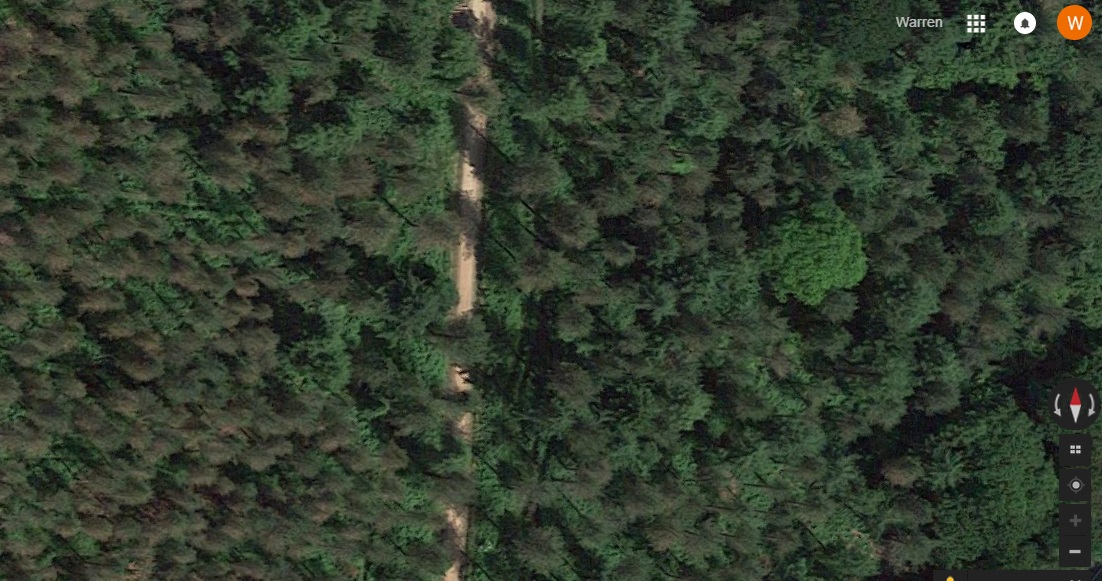
I've displayed below an aerial view courtesy of Google Maps of the pathway I'll be performing my shoot:


The next image is the closest zoom the utility will allow but both images convey a narrow path bordered either side by trees:


My plan is to shoot in portrait mode, convert the images to mono and then colour them and using some PS effects to help give me the look that I want, an apocalyptic type setting influenced from films I've seen, and perhaps a slight fear of the future should some scenario happen in the future.

The location is short distance from my home. It could be a journey I would take should I be without a car away from home home but travelling home, a place where we believe we are safe.

Part 2 Project Mapping and Other Technologies - Exercise 2.4: Is appropriation appropriate?

Part 2 Project Mapping and Other Technologies - Exercise 2.4: Is appropriation appropriate?

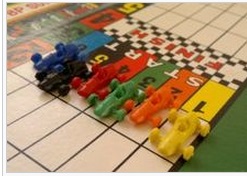
Interestingly Geoff Dyer's article on photographers using Google Street View mentions the 1960's board game Formula 1. 

http://www.guardian.co.uk/artanddesign/2012/jul/14/google-street-view-new-
photography?intcmp=239

I was born in the 1960's but as a teenager I recall playing this game with friends and my brothers. Dyer compares the difference of enjoying the thrills and spills in your own front room the Formula 1 game advertises it to be as a similar contrast to the stay at home photography to photographers such as Michael Wolf blowing up images taken by Google as part of their street view and calling it photography. The similarity being both are stay at home and arguably bear little resemblance to the activities both are supposed to represent

Formula 1 board game playing pieces


A Michael Wolf Google Street View image


Whilst the board cannot really be considered misappropriation, the game has used a sport, a theme, even an idea and translated it into something different. I'm not sure that Michael Wolf has done this. Had he used the general approach and gone out with his camera  and created similar images himself then I feel he could say he used an idea and created something himself e.g looking for something in his images he had not originally intended to capture, something exploratory also for him. In this instance I feel its misappropriation; arguably by doing something controversial he has created a response which has resulted in an increased profile of himself, this work and perhaps other works he has done. However it has led him on to develop his own individual approach and I think this is what we all do and take influence and adapt it to our design. 

Ultimately this can lead to what we may call a personal voice and start creating our own unique work that perhaps others might use to influence their own work. Engineers have done this since the wheel was first invented and as a result progress is made. Whilst photography is not as practical and world changing in the way engineering is, its still a progressive way of moving something forward. When something becomes static it could be considered dull eventually. This is something that can interpreted in a similar way to our careers and us as individuals. progression motivates and inspires us and others around us in what we do. Garry Winogrand did this with his images and the link below shows his own interpretation, a narrative, of elements within an image, elements I feel he discovered in retrospect after taking the image rather than intentionally capturing it, just like Wolf:


Photography should be about discovery, both for the viewers and the artists themselves. To have work influenced by others is something we should all do as this can be a stepping stone to developing our own ideas; its something that is common in photography since it forst began. Personally blatant appropriation of the work of others is unethical but its just my view


Tuesday, 9 February 2016

Part 2 Project Typologies and new Topographies - Exercise 2.3 Typologies

Exercise 2.3 Typologies


As i understand it typology is the grouping of classification of items within a certain type. I read it also could be the study of symbols but for photography its the grouping of images containing similar content or the photographer specifically imaging similar subjects. I suspect it might be a good idea if I was to do this for every pair of shoes / boots my other half has and carry the collection of images with me each time we went shopping. However I can't complain as she has been excellent in allowing me to progress my photographic interests which I'm sure is much more expensive.

Sometimes if you see much of the same thing the human brain can become somewhat disinterested, its looking for differences. If you watched too many horror films would you become less scared by them; if you saw too many comedies would your acceptance of slapstick wane and a requirement for more cerebral comedy develop? Looking back at my synopsis of the images produced by Donovan Wylie of the Maze I found myself becoming more intrigued. The article in the guardian below describes Wylie's images as clinical. yes, they were very sterile but I found myself absorbed by them, it made me feel as if I was there and I could feel the despair of someone who was. However I did not feel as if these were a collection of images in the traditional way, more so a journey exploring the surroundings of somewhere unpleasant

http://www.theguardian.com/artanddesign/2010/feb/08/new-topographics-photographs-american-landscapes

Interestingly Lewis Baltz in hs video clip says he feels art is something that you should think about rather than something that is just something interesting to look at; perhaps this is similar to the view of Roland Barthes and his thoughts around an image requiring Punctum rather than just the Studium. 

http://www.tate.org.uk/context-comment/video/tateshots-lewis-baltz

"...art needs a viewer else without it, it doesn't exist."


Stephen Shore created a series of images of American and Canadian landscapes in the 70's whilst "on the road" choosing to take them in colour


The images of o buildings, store fronts, even signs. I'd argue that they are specifically or of the typology of landscape, but perhaps urban landscape. In my earlier module People and Place there was an assignment called "A Sense of Place". Its difficult to know whether the images capture the sense of place at each location or simply what Shore wanted to show it as. The images in the main are bereft of people, most are perhaps a bit stark However it seems to have captured elements of the location, a street corner, a building, a sign post, a car park sometimes the inside of a motel room.

However I feel that these are not images he has quickly taken, but that he has developed intimacy with these locations, some of this comes across in these images. At first thought the starkness recedes and a feeling of intimacy comes across.

Nicolas Nixon used large format 8 x 10 on the basis it allowed him to capture a thicker slice of time opposed to a smaller camera capturing thinner slices of time.

Nixon's subject included many types such as school children and ill people in nursing homes


Whilst these are portraits they are not so much posed as captured, more observational but with the subjects knowledge their images were being taken. like Shaw's images above there is a repetition to them but also sufficiently different for the viewer to find interest in each.

Andreas Gursky, a German photographer, has produced sets of  images of buildings, storage yards from specific viewpoints that makes the viewer initially question what they are seeing. The distance appears to make the viewer immune to what they are seeing, clearly man made but so distance emotion seems to have deserted the images, not so much sterile but busy. There is enough here to interest the eye and for it to search and explore and wonder but I as the view feel a sense of detachment.

For those that may not recall Gursky's name I've displayed an image below that many will be familiar with:

I believe this image of the Rhine was displayed in a gallery at the size of 2 by 3.5 meters and draw some interesting responses from the public. I do find an interest in this image with the texture of grass, path, water, and sky (does this have a texture?) and of course the symmetry with the thin slice of grass across the river and that of the grey path. I almost feel the texture and movement of water or wind across the top of it in contrast to the other elements within the image. I wonder what i would feel had i viewed this up close and the size originally printed


Wednesday, 3 February 2016

Donovan Wylie the Maze Series, his influences, and what I've learnt from his approach

Donovan Wylie the Maze Series, his influences, and what I've learnt from his approach

Unfortunately as occasionally occurs in the module notes, the links don't always work. However I did listen on youtube to a number of interviews with Donovan Wylie which included:

https://www.youtube.com/watch?v=naoxP-iLvqU#t=272.721


I also discovered the following from part of the url in the course notes:


BELFAST EXPOSED ONLINE ARCHIVE:


http://www.belfastexposed.org/about_the_archive


Magnum holds a set of 80 Maze images produced by Donovan Wylie:

http://www.magnumphotos.com/C.aspx?VP3=CMS3&VF=MAGO31_10_VForm&ERID=24KL53Z3Z3

This is very interesting, the images are very repetitive and I realise that what he is trying to do is to express perhaps the feeling, the emotion of what prison life must be: monotonous, repetitive, bland. 

Up until image 40 there is no release from constantly viewing fencing on either side of the frame. The images are shown on my laptop at about 2 inches square but its amazing that I feel as if I am there and I am trapped, enclosed, and restricted. The images made me feel uncomfortable. Having just read Camera Lucida the "punctum" in these images is amazing. I think this could be one of the first times I have had such a feeling , though fleeting, of despair and instantly its made me connect to films we've discussed earlier in the course notes such as The Road, The Book of Ely, even Legend. Whilst these images make me feel enclosure, they also make me feel despair and this was something present in the films I mention but I feel it more from these images.

The images move on to what perhaps is an exercise yard, and a building and i almost feel I am pacing round this yard looking at elements i see everyday from different positions in the yard.

There are a series of images of what looks to be different cells which are exactly the same and the bed linen folded in almost military style; its the different window curtain in each cell that differentiates the cells, but only just. Working away from home mid-week and being restricted in the main to a hotel room reminds me of the hotel, sometimes different rooms but the layout the same, perhaps some pictures hung in the room differentiate the room.

The Maze held both political and criminal prisoners and I suspect a number of innocent people. If prison is seen to be a place to be punished then the monotony of everything would probably break all but the hardiest of men. However with punishment one would want to reform prisoners and I would wonder how this could happen.

This has been very inspirational to see the images and to listen to several of Donovan Wylie's interviews has helped me firm up my approach for Assignment 6 and given me suggestions for how I can further consider and re-formulate my ideas for Assignment 2 by using certain imagery styles to create an emotion, I aim for emotions of a specific nature, in the viewer. 

Interestingly in his video Outposts, the perimeter around the people is for security to keep people out as opposed to the Maze where its designed to keep people in:
https://www.youtube.com/watch?v=VQekhfX73zE

Monday, 1 February 2016

Roland Barthes - Camera Lucida

Roland Barthes - Camera Lucida

Roland Barthes was born in 1915 in Cherbourg France. Camera Lucida is considered his last major work and I found this book quite interesting. It is of course translated from French. The prose is understandably traditional of its time but its a very interesting book and written in almost 2 distinct but fairly short parts.

It appears to be initially a self reflective journey into understanding what photography is and the process to understand what makes a good photograph. He searches for something he finds evasive and tries to quantify what it is he feels makes a good photograph.  At some point during the writing of this book his Mother dies and the book takes a different, almost morbid slant. Barthes is not a photographer and so his analysis could be considered objective; he was known as theorist and philosopher.

Initially Barthes discusses portraits and how they don't seem to reflect the essence of the subject. Some of this he puts down to the subject pretending to show a different personality than the one they are; Barthes himself confesses how he feels uncomfortable as a subject. Toward the end of the book when searching to find a photograph that reflects the essence of his mother its telling that the one he feels best demonstrates this is one of her as a child, perhaps a child will more naturally display elements of them self that perhaps an adult may want to hide and change.

Barthes makes the statement that a photograph captures something which can never be repeated and of course this is true though Einstein said time is relative, and not absolute but I think in general terms Barthes is of course correct.

He breaks down the components of a photograph as i) the photographer, ii) the subject and iii) the viewer. The photograph he says is has studium and punctum. Barthes describes both and my interpretation of this is that the studium is initially what the viewer will see, perhaps what gains the viewers initial attention and gives context to the image, assuming the studium is sufficient. He then describes what makes a photograph special is one that has punctum, something that is not visible at first sight and needs to be discovered. Sometimes this discovery of punctum can cause an emotional reaction, or reaction as sharp as if pricked with something sharp.

I think its this punctum that my current tutor is encouraging me to consider and attempt to include as part of my photography e.g. invoke an emotion or memory, create or indicate a whiff of a story no matter how vague. I think this then makes the viewer work to try to understand the image, or perhaps using the photograph to connect to an historical thought or emotion or simply to just use the photograph as a stepping stone to another thought process.

Barthes does highlight a few elements in images as his personal punctum and whilst I may not always agree with his view of images, it doesn't matter because I think its what I find as the punctum in an image though it may not always be the same punctum for another viewer, or perhaps the base is but the rest individual. The feeling or thoughts invoked by the image may often be different but I think the point he makes is to consider this and to include this as part of the image. i could be wrong but its how I currently interpret what he is saying. It would be good to back to this book in the future and re-examine my thoughts on it

Barthes mother dies and his reflections change as result. I discover that he is not at all a social person and has spent much of his life caring for his poorly mother, shying away where possible from integration with other people. This could of course be a reason for why our views (Barthes and I) of studium and punctum may vary for different images as the elements of a photograph may invoke different thoughts because culturally or individually we may be different.

Following his mother's death he searches through his photographs looking to find an image of his mother that best shows off her character and one that he can use to remember her. There was an interesting part where he questioned dreams and when you see people in dreams do you really see them or do you just know what they look like. Cryptically this could also apply to a portrait captured by a photograph and perhaps returns to his opening statements in his book around portrait images not truly capturing the subject because the subject does not truly reveal them self to the photographer. As I mentioned at the start of my synopsis its almost ironic that the photograph he finds of his mother after her death that he fees most reflects the "truth of the face" he loved is one where she she is a 5 year old girl. There is something very romantic and pure in this revelation. The picture of his mother with her brother, his uncle, perhaps a studium, but the fact it invokes an emotional response as it appears to capture her essence, this punctum perhaps is only observable by Barthes, and perhaps his brother, maybe even her brother if he was still alive. Would the photograph of Barthes's mother invoke the same emotional response to other viewers? Not in the same way as Barthes experienced but knowing it was a child he grew to become someone's mother may invoke an emotion of life, and the inevitable death. The image itself may not invoke punctum in all but understanding its someone's mother and her death as a future parent caused much loss to her children would enable that puntum to be felt by many as they look inwards and the emotions they have for their own mother and wonder what she was like as a child, something we would likely not have seen Myself having lost both parents to cancer at young ages means they only saw 1 (for a short period) of 7 grandchildren and didn't really get to fully experience their roles as grandparents. These are the thoughts I might have had is seeing this image of his mother in a gallery where having looked at the image and understood it was someone's mother, I could close my eyes and then truly see the image and feel its personal punctum.

I found Barthes in his writings then went particularly morbid, perhaps still in mourning and unable to relieve some of his emotions by crying. he also seems to lose interest in the force of life and any particular reason for man's existence and and the existence of a potential supreme being.

I think Barthes started lose focus of what he thought made a photograph and instead began to associate a photograph with death, it captures something of the past and the unavoidable to be. The book also changes in that perhaps some elements at the start of the book are simply his theories and observations as the viewer, little of being the subject and none of being the photographer.  He moves from attempting to "interrogate the evidence of Photography" not from the view point of pleasure but from life and death. Its clear to me that in these statements he is focusing more on his mother, the loss her death has caused him and perhaps his own mortality.

This element of the book made me think of the TV series Sharpe, where Pete Postlethwaite who played Sergeant Hakes whom at various points in the TV series would take take off his hat to cry "mother" looking for help and support at the picture of his mother inside his hat.

Alas Barthes died at age 65 a month after being hit by a laundry van, some questioned if he lost the will to live whilst recuperating the chest injuries he suffered. 

Whilst a short book I found very interesting and that I could in the most part understand and reflect in some agreement of what he was saying. i wonder had his mother not died at this point she did whether Barthes' would have been different and if he would have reflected more on what a photograph was


Sunday, 24 January 2016

Part 2 Landscape as a Journey - Exercise 2.2: Explore a Road

Exercise 2.2: Explore a Road

Part 1 

This is a short series of photographs about a road near where I live. The road I've chosen is the road that joins the road where I live to Ruardean, the next village. Strangely this road doesn't have a name, Its a country road. The objective is to try to think about something about this road that is familiar to you in a different way.

Thinking ahead to the film I've selected I've created a number of images that I've processed in way I see as representative of the film The Road. I've achieved this by under exposing a full stop, converting to mono and then toning the image. Whilst this is a road I'm very familiar with and know its bends and dips / climbs very well my processing has been to give a slight dangerous and unknown edge to the road; to make it look a bit intimidating whether driving along it or walking it.


This is a very interesting approach and I've quite enjoyed making this set of images; especially being able to include a slight sinister element within the images. It will be interesting how others see these images.


Part 2

I'm asked to watch one of the films mentioned in in my course notes (or it could also be any other ‘road movie’ of my choice. Write a short review (around 500 words), focusing on how the road features within the film’s narrative.

 I've chosen "The Road" which is based on the book of the same name by the American author Cormac McCarthy. I've chosen this because its a DVD I have in my collection and a film I've watched at least 3  times previously and have enjoyed the story it tells. The book interestingly won McCarthy a Pullitzer prize for fiction in 2007.

As an overview of the film it’s about a father and young son making a journey on foot from their home toward the coast. However some apocalyptic event has already happened and the landscape the travel is a wasteland. This type of story exists in many films including the Mad Max series, The Book of Eli, I am Legend, and 28 Days Later/ 28 Weeks Later. This theme is also explored in the very popular game series Fallout. Whilst a road is not specifically followed for the whole journey for many parts of the film the main characters of the film are seen journeying along a road. During the film the story leading up to their journey is loosely explained though the reason for apocalyptic event is not explained.

The journey in prior to the apocalyptic event would, I think, be a fairly easy journey for the two travellers using either their own vehicle of public transport. Certainly taking provisions with them from their home for the journey and / or obtaining them along the way or at their destination would be a given. Instead the journey is portrayed as very difficult in terms of avoiding other scavenging people sometimes operating in gangs, and themselves having to scavenge for food a drink. A particular point in the film is made of the boy drinking a cola drink. He was born after the apocalyptic event but had never tasted a fizzy drink before, something he would most certainly have done had this event not occurred. 

It’s quite a harrowing film but the essence for me is that shows how easily things we can take for granted could easily change in the future and how hard it is just to survive in such conditions. Of course given the name of the book / film there are many scenes showing the father and son travelling along the road and other people, good, bad and indifferent they come into contact with. 

The film had a gritty feel and you could very easily empathise with main characters and feel their pain of what they encountered along the journey; you really wanted to complete their journey unharmed. It also shows the depths of depravity that some people will sink to in order to survive. I don't want to reveal any more about this film other than to say I found it rewarding, harrowing, emotional and perhaps scary of you think of it as potential future and its one that's believable without too much imagination. I've now watched this about 4 times and it still gives me the same feelings, a sense of despair and possible hope, but mostly despair. The book gets mixed reviews but it could one I would choose to read if I get chance

A road for all of us is a method from getting from one location to another and its taken for granted that we will achieve our goal with no or little disruption. If travelling by car its also an effortless journey.

The story shows how much more aware the travellers' have to be and how dangerous it is for a number of reasons. Given the previous exercise this aligns in that we need to take note and be aware of things that we might normally take for granted or simply not notice.

Looking at Nadav Kander's images from her set " In Yangtze - The Long River" there is a remoteness to the images she has captured. In some there are people, or signs of people but they are made to feel, in my interpretation, as if they don't belong, even in the ones where a hint at humour is seen. "Man" appears to pale in comparison to the scenes they are captured in. This theme in the film The Road also comes through, man is seen to be struggling in a hostile environment. Whilst the struggle is not so apparent in Kander's images, they do not portray man as being in harmony, and the feeling desolation and corruption where present is man made; likely that is also the case in the film The Road.

In our life's journey the same could apply and for a multitude of reasons some things we notice and pay attention to and some we don't. Its certainly an adventure and also one in which we encounter struggles, decisions and difficulties.

This review has helped me formulate some ideas for how I choose to approach Assignment 2

Monday, 11 January 2016

The Mississippi - An Interview with Alec Soth

The Mississippi - An Interview with Alec Soth

Seesaw, the online photography magazine published an interview with Alec Soth. I've detailed the link below for anyone else to read and enjoy:

I've detailed below my thoughts around the interview based on the exchange between hom and the interview and the very interesting points he made or at least thoughts that struck a chord with me

Like many successful photographers, a career photography was not Soth's first choice. Interestingly Soth claims photography is not really capable of having a story even though it may have narrative. As interviewer points often the narrative in a photograph is ambiguity and this is something my Landscape tutor has also pointed out to me. Perhaps this way that story in the photograph is different for each viewer and for a variety of reasons. Could this be like picking up a story book but there are big gaps or empty pages so you make some of the story up?

However Soth's work in his first book "Sleeping by the Mississippi" his work is described as fragments of a dream with no clear connectivity or viewing order. Soth through self experienced story claims that many great photographs are not necessarily created by great photographers but by luck, being in the right place at the right time, or perhaps the right place and the right time to capture the right moment. However I think he claims the more difficult element is putting together the images so that they become a collection and are stronger as a collection than their individual worth. 

This is quite an interesting point, whilst i have produced "sets" of images as part of my earlier modules I suspect these sets of images are in fact  images linked by a specific theme but remaining very rigid to the original brief and I've developed my intention sufficiently.

Soth's reasons for selecting the MidWest as the location for his images is because he feels an affinity with the area. This is important perhaps when trying to but a piece of yourself into the images, they take on a new level and the images have an emotional attachment for you.

Its an interesting concept that each image have a loose connection with the previous and the next image, however loose or vague that may be.

Looking through the images shown in the magazine I see there is a story of some kind waiting to be discovered or elaborated within what he has captured.

Looking through these images you can see how Soth really does like to create a story within his images. Whilst i do find the images very static there is a lot in the image to entertain my mind; there is something to discover, something to contemplate, something to imagine.

Earlier in the interview he speaks about his work being like poetry, the images having a repeatable rhythm. he also talks about photography being almost investigative, discovering something.

I find this interview, particularly Soth's way of describing his work, his vision etc very interesting. His images in this set also align with some feedback from my tutor for Assignment.....include or create some ambiguity within the images. Soth would say create a story, make a set that has a rhythm but don't make it too obvious to obvious. 

What I take mostly from this article is to be observant and use what is there to enable a story to be started, to have a flow within the images. It will be interesting to see how I can do this and how close I come to what reaching what I aspire to.